A small pantry doesn’t have to mean a messy one. In most apartments the problem isn’t space, it’s that the space you have isn’t working: deep shelves where things vanish, tall gaps nobody uses, and a door that does nothing.
The ideas below are built for renters. None of them need drilling, and every one can come with you when you move. Pick two or three to start, not all fifteen at once.
You’ll find what to do, why it works, and the type of organizer that helps, so you can set up a pantry that stays tidy past the first week.

Before you start
Ten minutes of prep stops you buying organizers that don’t fit.
- Empty one shelf at a time. Toss anything expired and group what’s left: snacks, baking, breakfast, cans, grains.
- Measure every shelf. Note width, depth and the height between shelves. Write it on your phone.
- Count your categories. Each group usually needs one bin or one zone, so this number tells you how many organizers to buy.
- Check the door. Measure its width and how far it can stick out before it hits the frame. This decides if an over-the-door rack fits.
The 15 ideas
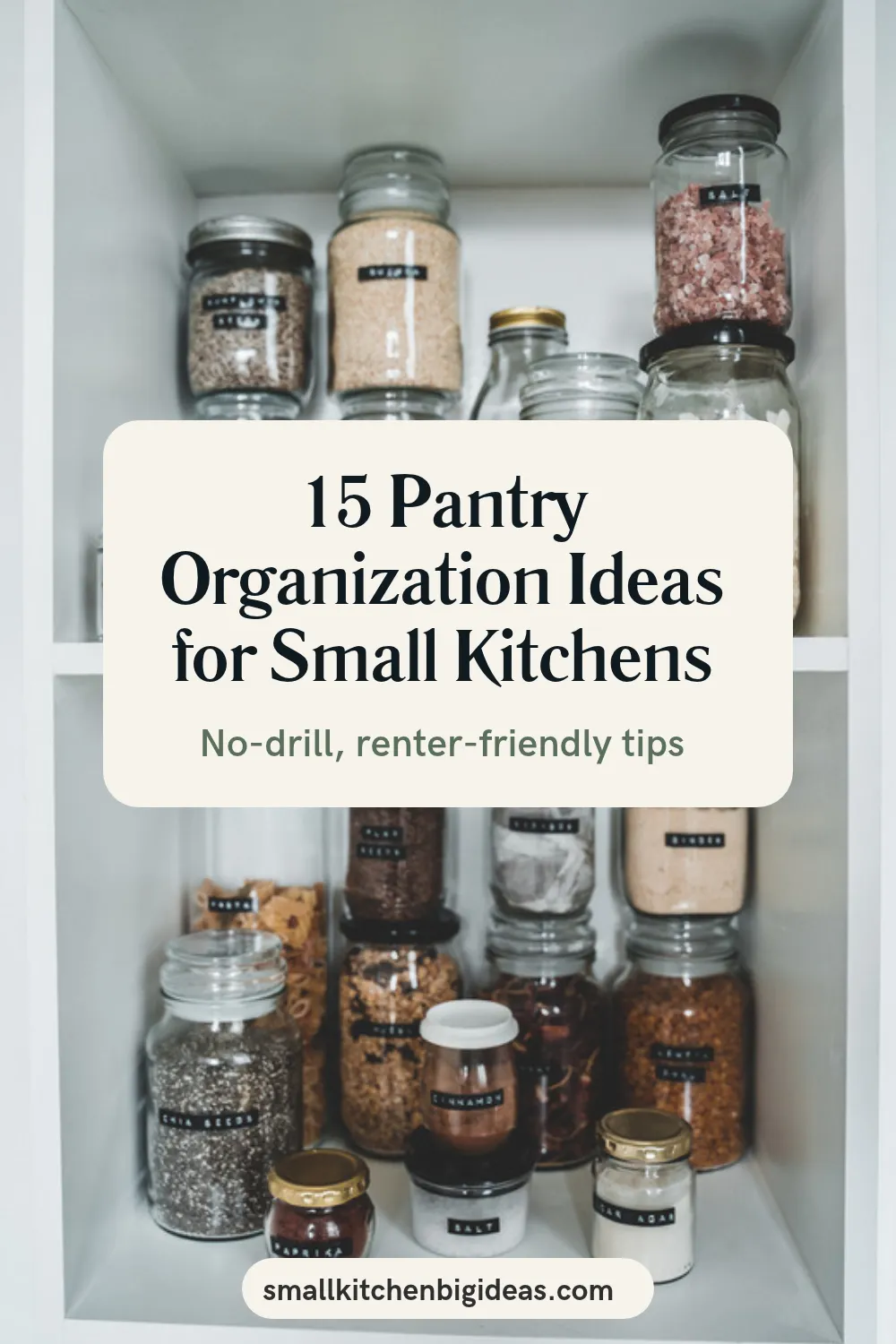
Decant dry goods into clear airtight canisters
Pasta, rice, oats and flour in matching clear canisters stack neatly and show you what’s running low. Square canisters waste less shelf space than round ones.
Shop Amazon Basics 10-piece square airtight food storage containers
Use shelf risers to double a shelf
A wire or bamboo riser creates a second level for mugs, cans or jars. It’s the quickest way to use tall gaps between shelves.
Shop YouCopia UpSpace adjustable-height shelf riser
Add a turntable for oils and sauces
A lazy Susan in a corner or at the back of a deep shelf brings bottles to the front with one spin.
Shop Copco non-skid 2-tier 12-inch lazy Susan turntable
Hang an over-the-door rack
The back of the pantry door can hold spices, snacks and wraps. Over-the-door racks hook on, so there are no holes in the door.
Shop No-drill 6-tier over-the-door pantry organizer
Give every category its own bin
One bin for snacks, one for baking, one for breakfast. You pull out the bin, grab what you need and slide it back.
Shop iDesign stackable clear pantry bin with handles
Label everything
Labels keep the system going when other people in your home put things away. Use removable labels so they don’t damage bins.
Shop Preprinted waterproof, removable pantry labels (308 pack)
Store cans on a tiered can rack
A tiered or rolling can rack shows every label at once, so you stop buying a third can of tomatoes.
Shop Simple Houseware stackable can rack organizer
Use under-shelf baskets
Baskets that slide onto a shelf add a hanging layer underneath for bread, wraps or snack packs. No tools needed.
Shop Simple Houseware under-shelf wire basket
Put deep shelves on pull-out drawers
If your shelves are deep, things get lost at the back. A pull-out bin, or a sliding drawer that sticks in with adhesive instead of screws, brings the back to you.
Shop AmzAge no-drill pull-out cabinet drawer (adhesive mount)
Keep the floor for heavy and bulk items
Potatoes, onions, drinks and big bags of rice go on the floor in a basket or rolling cart. This frees shelves for daily items.
Shop Amazon Basics 3-tier rolling utility cart
Use a slim rolling cart in the gap
The narrow space beside the fridge or between cabinets often fits a 5-6 inch rolling cart. It works as a pull-out mini pantry.
Shop VASAGLE 5.1-inch slim rolling storage cart
Group by how you use it, not by what it is
Keep breakfast items together, lunch box items together and baking items together. Mornings get faster when everything for one job sits in one spot.
Put daily items at eye level
What you use every day goes on the middle shelves. Rarely used items go up high or down low.
Add a stick-on light
Dark pantries make good organization pointless. Battery motion-sensor lights stick on with adhesive and turn on when you open the door.
Shop YLXS rechargeable magnetic motion-sensor cabinet lights (3 pack)
No pantry? Make one on open shelves or a cabinet
If you don’t have a pantry at all, use one tall cabinet or a freestanding shelf with matching bins and canisters. The same rules apply: clear containers, categories, labels.
Shop Slim 12-inch-wide freestanding pantry cabinet with adjustable shelves

Mistakes to avoid
- Buying organizers before measuring. Bins that are 1 inch too tall are useless.
- Using round containers on small shelves. They waste the corners; square ones fit more.
- Over-organizing. Twenty tiny labeled jars are hard to keep up. Start with broad categories.
- Hiding things in opaque bins without labels. If you can’t see it or read it, you’ll forget it.
- Ignoring the door and the floor. They’re often the biggest unused space in a small pantry.
Start with one shelf
Start with one shelf this week. Clear containers, a few bins and labels will make your pantry feel twice as big, and you can take all of it with you when you move.